

Cricket keeps finding late bloomers who refuse to be defined by where they started. Ravisrinivasan Sai Kishore, the tall, relentlessly improving left-arm spinner from Chennai, belongs to that stubborn tribe. He didn’t crash the door down with instant superstardom; he kept upgrading himself season after season: first in age-group cricket, then in Tamil Nadu’s white-ball setup, then in the TNPL cauldron, and finally into a consistent IPL presence and a maiden India cap at the 2023 Asian Games.
Today, he sits at a fascinating intersection: a proven domestic match-up bowler with leadership stripes in the TNPL, and a spinner whose IPL 2024–25 stretch finally turned curiosity into conviction. If selectors prize repeatable skills, temperament, and steady expansion of his game (including handy batting), Sai’s case for longer India runs is no longer a whisper; it’s a dossier.
Sai Kishore Rooted in Chennai:
The thumbnail is simple: left-hand bat, slow left-arm orthodox, Chennai-raised, unusually tall for a spinner. The reality is richer. By the time Sai Kishore debuted across formats for Tamil Nadu (2017), he’d already internalized a working philosophy, doing the boring things brilliantly. That showed up in his economy obsession, repeatable lengths, and willingness to bowl in hard overs. The 2018–19 Ranji season was his first big red-ball receipt: 22 wickets, the most for Tamil Nadu. White-ball numbers followed, then the leap to the TNPL as a frontline bowler and on-field leader. Each step looked incremental together; they formed a spine.
Why it mattered (snapshots):
- First-class rise: Tamil Nadu’s top wicket-taker in Ranji 2018–19 (22).
- Multi-format grounding by 2017–18 ensured he wasn’t a T20-only product.
- Height (≈1.96m) gave him bounce and a steeper point of release in Indian conditions.
TNPL: The Leadership Laboratory:
Ask anyone who followed TNPL 2025 closely, and they’ll tell you: Sai wasn’t just bowling for Idream Tiruppur Tamizhans, he was leading them, reading surfaces, setting funky catchers, even winning tosses opposite R Ashwin. That captaincy lens sharpened his tactical feel for match-ups and pace off the ball. It also showcased his range: one night he’s defending with fields on slow decks; on another, he’s shuffling the batting order, promoting himself when the chase needs a left-hander to break a leg-spinner’s rhythm.
There were flashpoints, too. Ashwin’s animated LBW moment versus Sai became a micro-drama of TNPL’s intensity, but underneath was a story of a senior pro steering a young room. The league’s most successful franchise historically is Chepauk Super Gillies, and Sai has worn those colors before; in 2025, he fronted TT’s charge and brought that culture of clarity with him. The TNPL stage may be regional, but its pressure-packed stands, televised scrutiny, and short turnarounds are big-league. Leading in that noise leaves marks that selectors notice.
SMAT takeoff: the season that changed the conversation
There’s always a season that turns potential into proof. For Sai, that was the 2019–20 Syed Mushtaq Ali Trophy: tournament leading wicket-taker with 20 strikes at a stingy 4.63 economy. It was the clearest signal that his skill set scales against India’s best domestic hitters. The haul wasn’t a fluke; it was a method, nagging angles from wide of the crease, hitting the top of off from different release points, and never telegraphing pace. That year essentially copyrighted his T20 identity.
Numbers that travel:
- SMAT 2019–20: 20 wickets (No.1 in the competition).
- Economy under 5 across a whole tournament, rare air in Indian T20s.
- Set the template for later IPL and TNPL roles: powerplay overs + middle choke.
Apprenticeship to impact: CSK nets to Gujarat Titans:
Before he became a regular TV graphic, Sai was a familiar face in CSK’s nets and analyst notebooks. CSK bought him in 2020 (₹20 lakh), but game-time never came; the learning did. In 2022, the Gujarat Titans invested ₹3 crore and later used an RTM for ₹2 crore in 2025, two market signals that franchises saw more than a situational bowler. The Titans’ dressing room, overflowing with elite spinners, was both a classroom and an audition. That environment, plus his SMAT pedigree, lowered the lag between potential and performance. By 2024, he was no longer “depth”; he was in the plan.
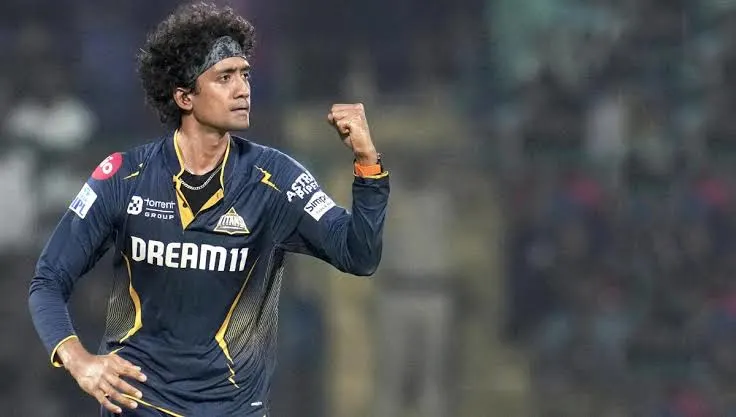
Career beats (franchise):
- CSK contract (2020) at base; no caps but maximum learning.
- GT pick (2022) and title-winning ecosystem to grow in.
- RTM at the 2025 auction underscores sustained demand.
The IPL Proof Points (2024–25):
Two things convinced even skeptics: a four-for to floor Punjab in 2024 and a full-season return in 2025. The 2024 spell, 4/33 vs PBKS at Mullanpur, showed he could break innings rhythm on true decks. In 2025, he built on that with 19 wickets in 15 games as GT’s second-highest wicket-taker, helping push them into the playoffs. That run wasn’t padded by easy overs; he was asked to bowl when batters were set and fields were up. The impact was visible beyond numbers too calm huddles, clear plans, and a willingness to own tough match-ups. That’s the difference between a spot bowler and a trusted one.
Receipts:
- 4/33 vs PBKS (Apr 21, 2024) in a three-wicket GT win.
- 19 wickets in IPL 2025; key in GT’s playoff push.
- Media consensus: from fringe to regular contributor.
Blue-jersey glimpses: Asian Games and the India door
October 3, 2023, Hangzhou. Sai makes his T20I debut vs Nepal and contributes throughout the competition as India takes gold. The Asian Games weren’t the Wankhede, but they were still India caps under pressure, and he looked like he belonged. Across the tournament, he bagged four wickets, including a standout 3/12 vs Bangladesh. That cameo matters because it proved the skill of translation in unfamiliar conditions and with a new group. Since then, he has lived in every “next-in-line” conversation for India’s spin battery. As a 28-year-old with high-floor fundamentals and growing confidence, he fits two selectors’ checkboxes: plug-and-play T20 overs now; long-format potential later.
Why does his Left-Arm Orthodox Bite more than it Looks?
When a delivery that lands on middle finishes kissing off-stump, you’re seeing geometry plus patience. Sai’s height creates bounce; his wider release can pull a batter across off; and his pace variance stays inside a narrow band so nothing feels “floaty.” The outcome is unspectacular to the naked eye but infuriating to batters, dot, push, mistake. Add a seam that stays upright and a willingness to start in the power play, and you get a bowler whose best ball is repeatable, not rare. That’s why coaches trust him on flat evenings and why captains toss him over before timeout.
Trait checklist:
- Tall release = steeper drop and surprise bounce.
- Control and repeatable pace bands keep batters guessing.
- Comfortable in powerplay and middle overs.
The economic obsession from his early years never left; it just learned to hunt wickets without losing thrift. Even in franchise bios, rivals highlight his “control” as the superpower, a compliment from opponents you can’t buy in auctions.
Lessons from TNPL Battles Against Senior Pros:
One of the understated advantages of Sai Kishore’s TNPL journey has been his repeated face-offs against seasoned pros like R Ashwin, Washington Sundar, and other India-capped cricketers. These contests often doubled as cricketing classrooms, testing not just his skill but also his temperament. Unlike nets, these were televised, pressure-packed evenings where reputations were on the line, and Sai had to hold his nerve.
For a bowler still shaping his craft, standing across from Ashwin, arguably India’s most cerebral spinner, and still executing his plans with clarity was an invaluable education. Each duel added fresh layers to his tactical understanding, teaching him when to attack, when to defend, and how to disguise his stock delivery. Beyond statistics, these battles gave him an unshakable belief that his method works even against India’s best. That confidence has carried into the IPL, where he no longer looks like a newcomer but a peer.
Adding Runs to the Sai’s TNPL History:
TNPL 2025 quietly reframed him as more than a bowler. Starting down the order, he walked in at No.3 across multiple games, finishing with a crisp 55 (34) in one of them. Not a slogger’s cameo, this was tempo batting: back-foot punches at 135+, inside-outs over cover versus spin, and calm strike rotation when fields spread. For IPL teams, that’s not trivia; it’s an extra lever for roster flexibility. For national selectors, it’s a nudge toward the “bowling all-rounder” bucket in white-ball squads. The net outcome is optionality: if he can enter at 7/8 and flat-bat 12–18 against pace while still delivering four overs at sub-8, he’s no longer competing only with specialist spinners; he’s competing with all-rounders for two different roles.
Why it matters now:
- Recent TNPL knocks show intent and method, not just license.
- Flexibility to bat in the top three situationally.
- Complements his primary value: four overs of control.
From Regional Hero to National Prospect:
The most telling arc of Sai Kishore’s story is how he transitioned from being a TNPL crowd favorite to a serious national contender. TNPL gave him recognition among Tamil Nadu fans; the Syed Mushtaq Ali Trophy gave him numbers; and the IPL transformed those building blocks into nationwide visibility. Each platform served as a stepping stone, but what unites them is his consistency, rarely going through long barren patches.
By the time he wore India colors at the Asian Games, it felt less like a surprise and more like a natural progression. He had already done the miles in smaller stages, earned the respect of teammates and opponents, and developed resilience against failure. For fans who’ve watched him from his TNPL debut, the rise is personal, a local hero who showed up every season until selectors couldn’t ignore him. For the rest of India, he’s now the quiet left-arm spinner who suddenly looks ready to stay.
Conclusion:
Sai Kishore’s rise isn’t a fairy tale; it’s a systems story. Local grind in Chennai, tournament-shaping SMAT 2019–20, captaincy and adaptability in TNPL 2025, and finally the IPL stretch that turned selectors’ heads, all of it points to a cricketer who keeps upgrading. He’s tall without being slow, accurate without being predictable, and ambitious without losing humility. India squads will always have an overflow of spinners; the ones who stick bring repeatable skills and a second dimension. Sai is assembling both. If 2024–25 proves he can do it week after week, the next block is obvious: do it in blue, across tours, formats, and situations until the conversation shifts from “prospect” to “piece.”
FAQs:
He debuted in T20Is at the 2023 Asian Games on October 3, 2023, vs Nepal in Hangzhou.
4/33 for Gujarat Titans against Punjab Kings at Mullanpur on April 21, 2024.
Yes, In TNPL 2025, he captained Idream Tiruppur Tamizhans, frequently squaring off with R Ashwin’s Dindigul Dragons.
He was the tournament top wicket-taker in SMAT 2019–20 with 20 wickets at 4.63 econ; earlier, he topped Tamil Nadu’s Ranji 2018–19 charts with 22.
A combination of control + adaptability (powerplay and middle overs), a strong IPL 2025 with 19 wickets, growing leadership, and improving batting utility.

Anshu is a content enthusiast with a passion for exploring entertainment and media trends. At YouTrial.TV, he brings his knowledge of streaming platforms and recommendations to help users make the most of their viewing experience. Anshu enjoys staying up-to-date with the latest in the digital world and sharing valuable insights with readers.